Why this collection pulls search traffic
For visitors searching a second-tier American museum with first-rate Chinese art, Cleveland gives a precise answer. It also creates a strong internal link path between museum pages and object detail pages.
Search intent this page covers
Objects in this guide
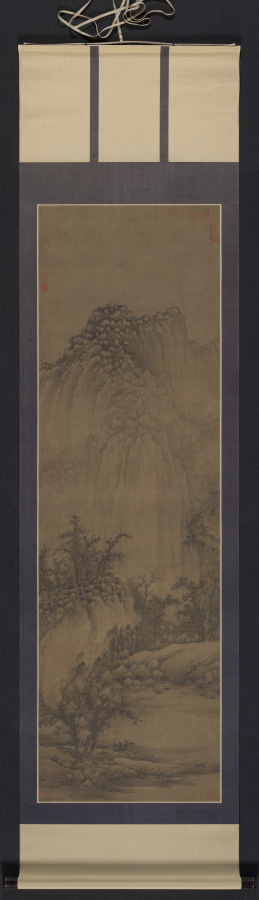
Northern Song dynasty · Paintings
Buddhist Retreat by Stream and Mountains
溪山兰若图
A towering ink mountain dominates the composition, capped with the round 'alum-head' boulders and wet ink dots that became Juran's signature. The Buddhist hermitage at the foot of the cliff is almost hidden — the point is the immensity of nature, not the human dwelling.
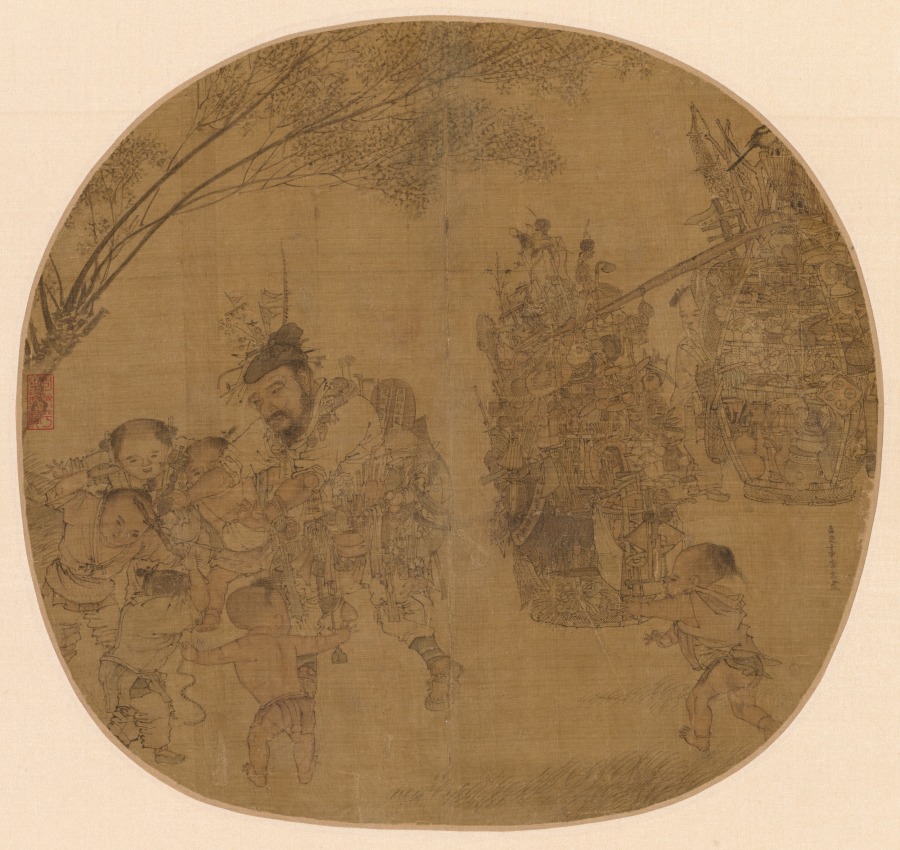
Southern Song dynasty · Paintings
The Knickknack Peddler
货郎图
A tiny silk album leaf packed with detail: a peddler's two enormous baskets bristling with hundreds of toys, fans, brushes, and skull-shaped trinkets, while children attack a snake nearby. Painted in 1212 for the Southern Song court of Emperor Ningzong.

Southern Song dynasty · Paintings
Cloudy Mountains
云山图
Mi Youren painted this handscroll in 1130 to thank a host who had sheltered him after the Jurchen invasion drove the Song court south. The mountains dissolve into mist; the brushwork is built almost entirely from layered wet dots — the famous 'Mi-dots' pioneered by his father, Mi Fu.
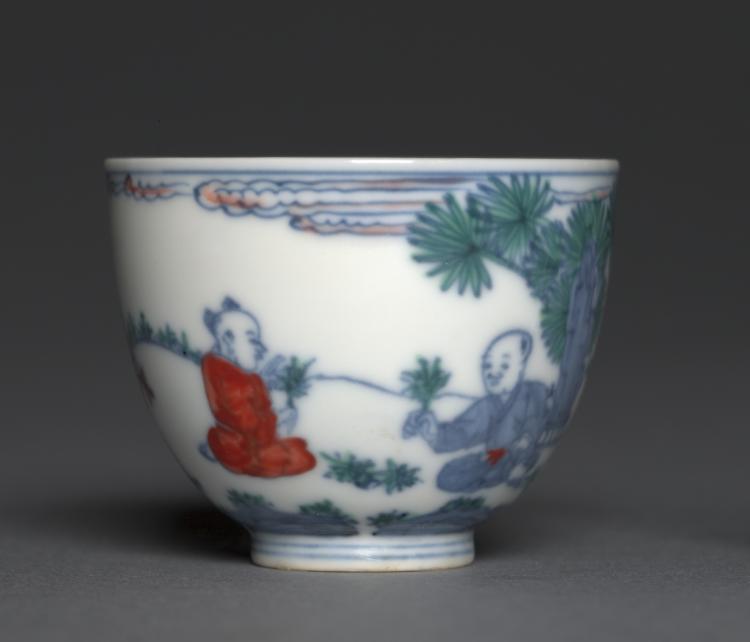
Ming dynasty, Chenghua mark and period · Ceramics
Wine Cup with Children at Play
明成化斗彩婴戏纹杯
Just two inches tall, this Chenghua doucai cup is the rarest of all classic Chinese porcelains. The body is paper-thin and translucent; the children at play are outlined in cobalt under the glaze, then completed in red, green, and yellow enamels above it — a two-firing technique perfected only at Chenghua's kilns.
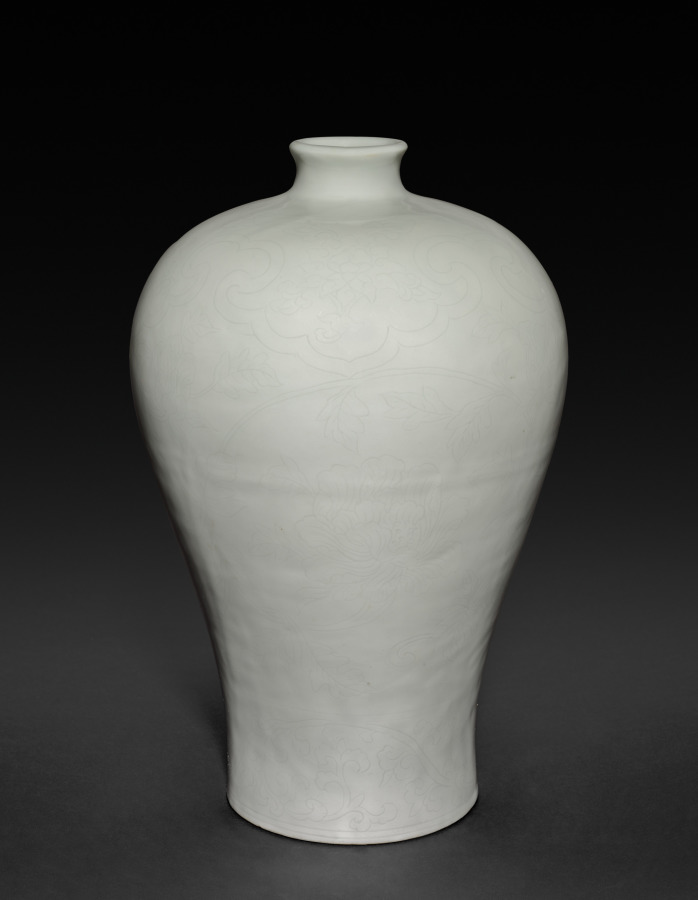
Ming dynasty, Yongle reign · Ceramics
'Sweet White' Meiping with Cloud Collars
明永乐甜白釉暗花梅瓶
A Yongle imperial meiping in tianbai (甜白, 'sweet white') glaze: a milky white porcelain so pure that the Yongle emperor used it for ritual offerings on the imperial altar. The decoration is incised into the body so faintly you only see it when light catches the surface — the so-called anhua, 'hidden decoration'.
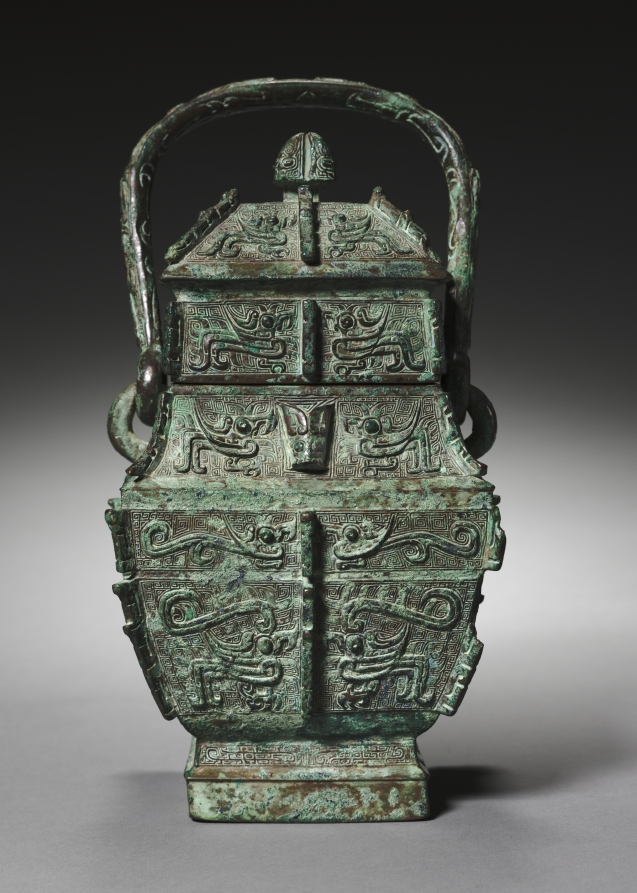
Late Shang dynasty, Anyang phase · Metalwork
Square Wine Container (Fangyou)
商方卣
A rare squared-section ritual wine container from the late Shang capital at Anyang. The body is wrapped in bands of crested birds (kuifeng) silhouetted against a dense ground of spiral leiwen — and the perfectly squared profile is itself a technical brag, far harder to cast than the standard rounded shape.
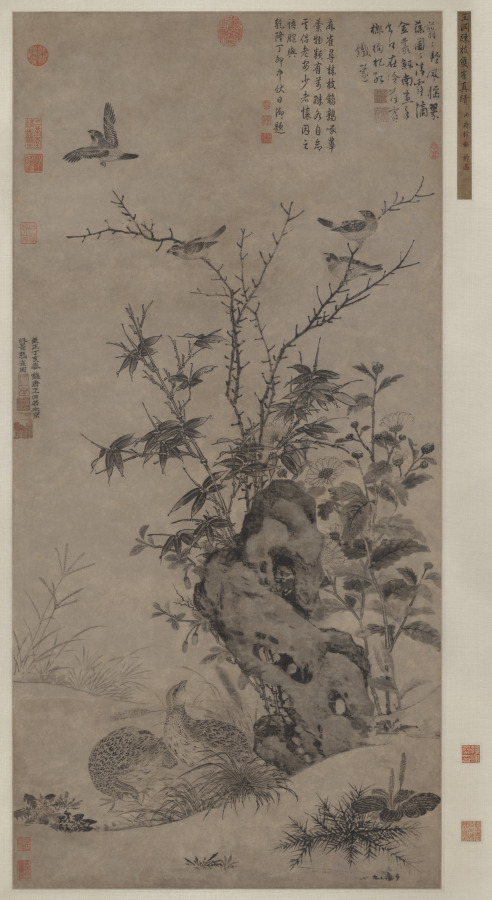
Yuan dynasty · Paintings
Quails and Sparrows in an Autumn Scene
秋景禽雀图
A flower-and-bird painting executed entirely in ink — no color — by Wang Yuan, who studied as a child under the great Yuan scholar-official Zhao Mengfu. Quails crouch beneath autumn millet while sparrows perch on the dry stalks above; every leaf, feather, and seed is rendered with academic precision.

Late Ming dynasty · Paintings
The Five Hundred Arhats
五百罗汉图
A handscroll over 26 metres long depicting 447 luohans (arhats), 72 attendants, and the bodhisattva of compassion at the very end. The luohans are climbing trees, riding tigers, walking on water, conjuring dragons — every supernatural ability the texts ascribe to them, all on one continuous strip of paper.
Frequently Asked Questions
What is the Cleveland Museum Chinese collection best known for?
For visitors searching a second-tier American museum with first-rate Chinese art, Cleveland gives a precise answer. It also creates a strong internal link path between museum pages and object detail pages. The strongest themes here are Song and Yuan landscape painting, Ming doucai and imperial ceramics, Shang and Zhou bronze ritual vessels.
Which objects should I start with?
Start with Buddhist Retreat by Stream and Mountains, The Knickknack Peddler, Cloudy Mountains, Wine Cup with Children at Play. These pieces give you the fastest read on the collection's core strengths.
Can I use this page to plan a visit?
Yes. It is designed as a quick orientation page before you check the museum's current hours, gallery numbers, and ticket rules.
Why does this page focus on search intent?
Museum-name searches are some of the highest-intent queries in heritage SEO. This page gives those searches a direct answer and then sends readers into object-level detail.
Are the object records connected to source catalogs?
Yes. Every object card links to the underlying record or collection page, and the surrounding context is written to help you read those records faster.