Wine Cup with Children at Play
明成化斗彩婴戏纹杯
Just two inches tall, this Chenghua doucai cup is the rarest of all classic Chinese porcelains. The body is paper-thin and translucent; the children at play are outlined in cobalt under the glaze, then completed in red, green, and yellow enamels above it — a two-firing technique perfected only at Chenghua's kilns.
Object Facts
- Period
- Ming dynasty, Chenghua mark and period (1465–1487)
- Date
- 1465–1487
- Medium
- Porcelain with underglaze blue and overglaze enamel (doucai 'joined colors')
- Dimensions
- H. 4.8 cm
- Held by
- The Cleveland Museum of Art
Cleveland, USA - Accession
- 1957.61
Cleveland Museum of Art — Severance and Greta Millikin Collection
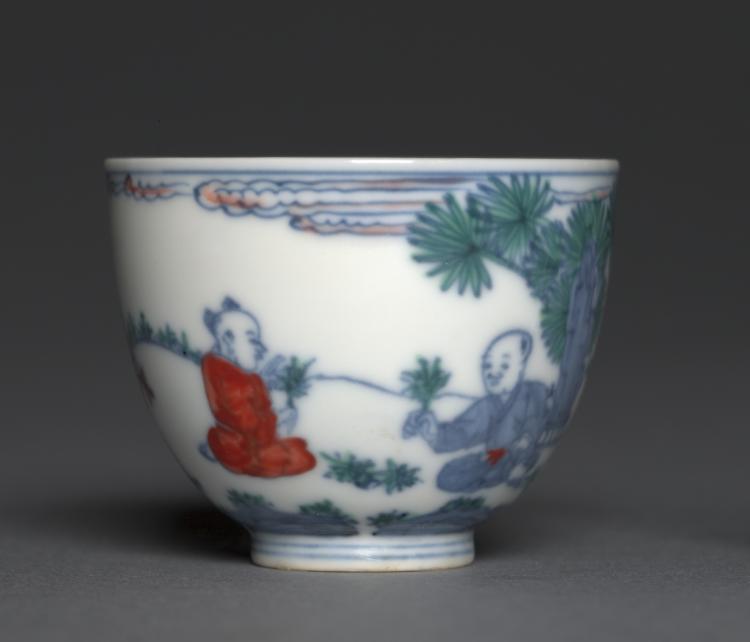
Why it matters
Chenghua doucai cups have sold at auction for the price of skyscrapers. Sotheby's Hong Kong sold a related 'chicken cup' in 2014 for HK$281M. They define the apex of Chinese imperial porcelain technique.
How it travelled
Probably exported from the Qing palace through Beijing dealers in the late 19th century, passing through Japanese tea-ware collectors. Cleveland acquired it via the Millikin fund in 1957 — recognised even then as a once-in-a-lifetime opportunity.
Frequently asked questions
Where can I see Wine Cup with Children at Play?+
Wine Cup with Children at Play is held by the The Cleveland Museum of Art in Cleveland, USA. Accession number 1957.61. Online catalogue record: https://clevelandart.org/art/1957.61.
When was Wine Cup with Children at Play created?+
Wine Cup with Children at Play dates to 1465–1487, during the Ming dynasty, Chenghua mark and period (1465–1487).
What is Wine Cup with Children at Play made of?+
Wine Cup with Children at Play is a wine cup executed in porcelain with underglaze blue and overglaze enamel (doucai 'joined colors'), measuring H. 4.8 cm.
How did Wine Cup with Children at Play end up at the Cleveland Museum?+
Probably exported from the Qing palace through Beijing dealers in the late 19th century, passing through Japanese tea-ware collectors. Cleveland acquired it via the Millikin fund in 1957 — recognised even then as a once-in-a-lifetime opportunity.
Can I reuse the photograph of Wine Cup with Children at Play?+
Yes. The Cleveland Museum has released the image under Creative Commons Zero (CC0), so it is free for any use, commercial or non-commercial, with no attribution required (though attribution is appreciated).
More Chinese pieces at Cleveland Museum
Other Chinese works in the The Cleveland Museum of Art collection.
Northern Song dynasty · Paintings
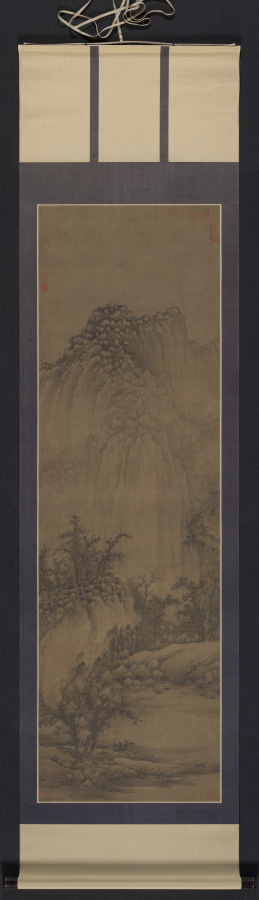
Buddhist Retreat by Stream and Mountains
溪山兰若图
A towering ink mountain dominates the composition, capped with the round 'alum-head' boulders and wet ink dots that became Juran's signature. The Buddhist hermitage at the foot of the cliff is almost hidden — the point is the immensity of nature, not the human dwelling.
Southern Song dynasty · Paintings
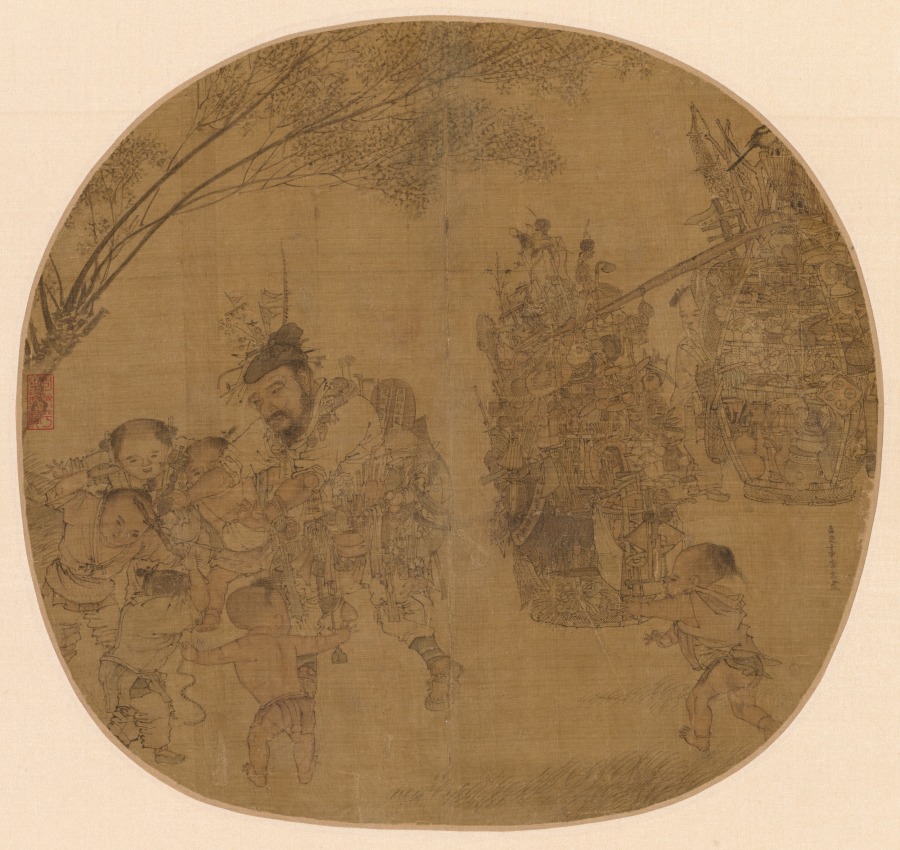
The Knickknack Peddler
货郎图
A tiny silk album leaf packed with detail: a peddler's two enormous baskets bristling with hundreds of toys, fans, brushes, and skull-shaped trinkets, while children attack a snake nearby. Painted in 1212 for the Southern Song court of Emperor Ningzong.

Southern Song dynasty · Paintings
Cloudy Mountains
云山图
Mi Youren painted this handscroll in 1130 to thank a host who had sheltered him after the Jurchen invasion drove the Song court south. The mountains dissolve into mist; the brushwork is built almost entirely from layered wet dots — the famous 'Mi-dots' pioneered by his father, Mi Fu.
From the same era
Other treasures abroad sharing themes or period with this work.
Tang dynasty · Paintings
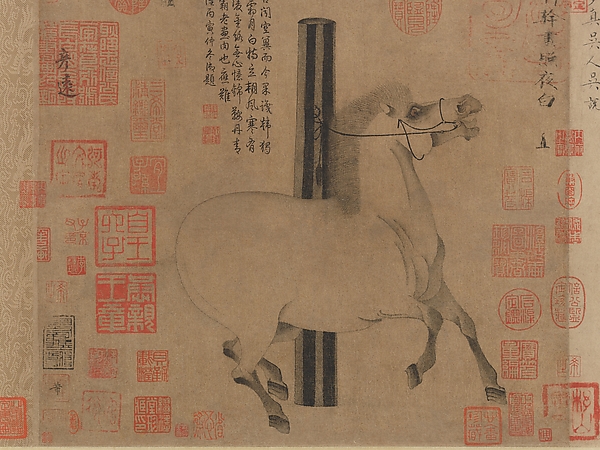
Night-Shining White
照夜白图
The single most celebrated painting of a horse in Chinese art. Han Gan's ink drawing of Emperor Xuanzong's favourite charger, 'Night-Shining White', has been treasured by collectors for over 1,270 years — its scroll is covered end to end in colophons and seals of the emperors, scholars, and dealers through whose hands it passed.
Ming dynasty, Wanli mark and period · Ceramics
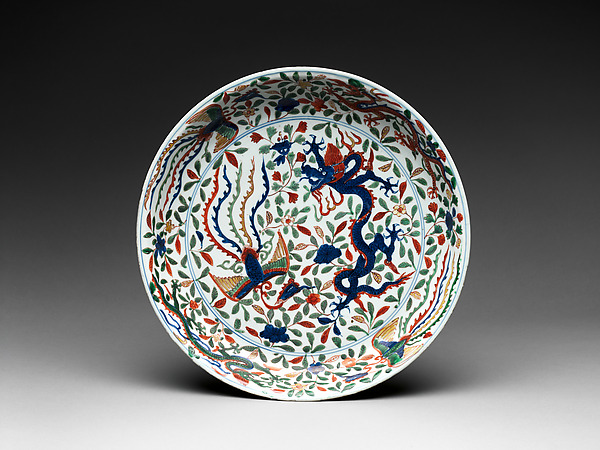
Dish with Dragon and Phoenix
明万历五彩龙凤纹大盘
An imperial Wanli wucai ('five-colour') dish, bearing the reign mark of one of the Ming dynasty's most profligate emperors. A five-clawed dragon (the emperor) and a phoenix (the empress) circle one another in a conventional symbol of imperial harmony.
Ming dynasty, Jiajing mark and period · Ceramics
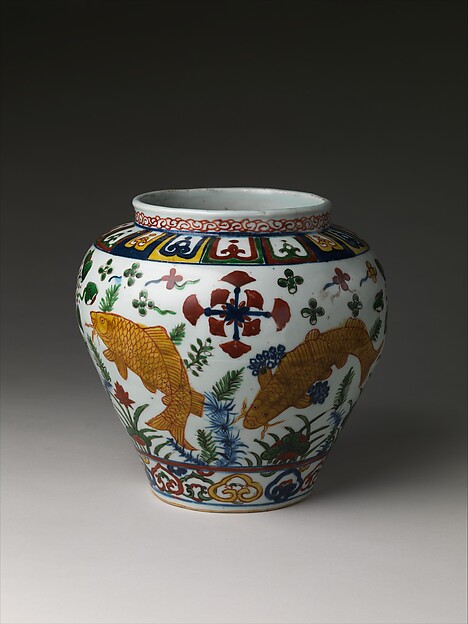
Jar with Carp in a Lotus Pond
明嘉靖五彩鱼藻纹罐
A masterpiece of Jiajing wucai porcelain: carp gliding through tangled lotus stems, painted in five overglaze enamels above an underglaze cobalt outline. The carp (鲤, lǐ) puns on profit (利) and is one of the densest auspicious symbols in Chinese decorative art.