The Knickknack Peddler
货郎图
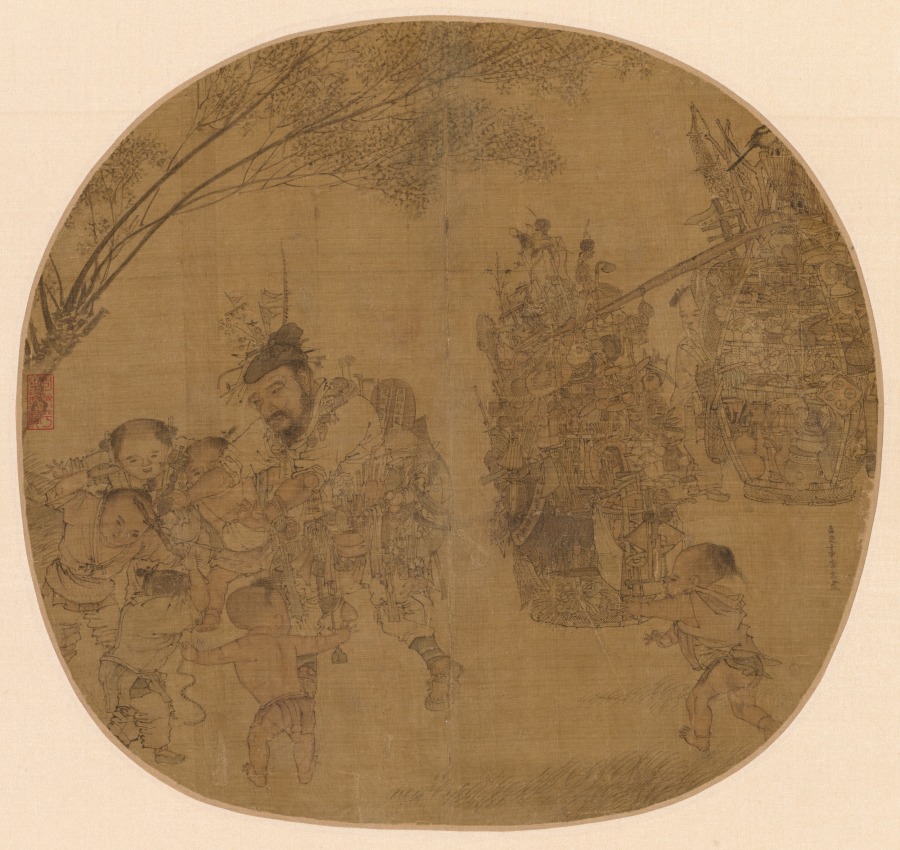
A tiny silk album leaf packed with detail: a peddler's two enormous baskets bristling with hundreds of toys, fans, brushes, and skull-shaped trinkets, while children attack a snake nearby. Painted in 1212 for the Southern Song court of Emperor Ningzong.
Object Facts
- Period
- Southern Song dynasty (1127–1279)
- Date
- 1212
- Artist
- Li Song (李嵩)
- Medium
- Album leaf; ink and color on silk
- Dimensions
- 24.1 × 26 cm
- Held by
- The Cleveland Museum of Art
Cleveland, USA - Accession
- 1963.582
Cleveland Museum of Art — Severance and Greta Millikin Purchase Fund
Why it matters
Li Song's peddler scenes are the earliest surviving Chinese paintings to inventory the material culture of ordinary urban life. Look at the upper-left basket and you can find an upside-down skull — a memento mori hidden in a children's painting.
How it travelled
Passed through Ming and Qing literati collections (with their characteristic seals) before entering the Tokyo dealer market in the early 20th century. Cleveland acquired it in 1963 with the Severance Millikin fund, established expressly for masterpiece-level Asian acquisitions.
Frequently asked questions
Where can I see The Knickknack Peddler?+
The Knickknack Peddler is held by the The Cleveland Museum of Art in Cleveland, USA. Accession number 1963.582. Online catalogue record: https://clevelandart.org/art/1963.582.
When was The Knickknack Peddler created?+
The Knickknack Peddler dates to 1212, during the Southern Song dynasty (1127–1279).
Who made The Knickknack Peddler?+
The Knickknack Peddler is attributed to Li Song (李嵩). The work is a album leaf executed in album leaf; ink and color on silk.
How did The Knickknack Peddler end up at the Cleveland Museum?+
Passed through Ming and Qing literati collections (with their characteristic seals) before entering the Tokyo dealer market in the early 20th century. Cleveland acquired it in 1963 with the Severance Millikin fund, established expressly for masterpiece-level Asian acquisitions.
Can I reuse the photograph of The Knickknack Peddler?+
Yes. The Cleveland Museum has released the image under Creative Commons Zero (CC0), so it is free for any use, commercial or non-commercial, with no attribution required (though attribution is appreciated).
More Chinese pieces at Cleveland Museum
Other Chinese works in the The Cleveland Museum of Art collection.
Northern Song dynasty · Paintings
Buddhist Retreat by Stream and Mountains
溪山兰若图
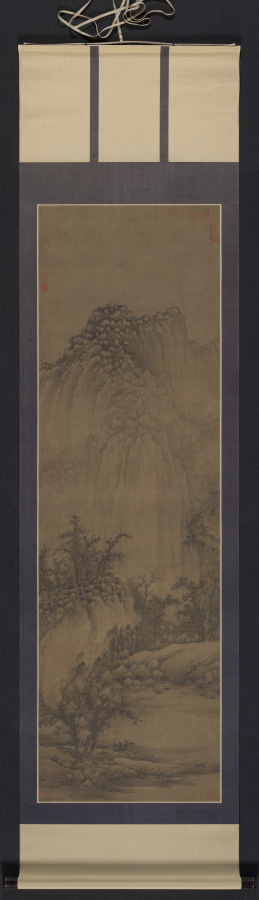
A towering ink mountain dominates the composition, capped with the round 'alum-head' boulders and wet ink dots that became Juran's signature. The Buddhist hermitage at the foot of the cliff is almost hidden — the point is the immensity of nature, not the human dwelling.

Southern Song dynasty · Paintings
Cloudy Mountains
云山图
Mi Youren painted this handscroll in 1130 to thank a host who had sheltered him after the Jurchen invasion drove the Song court south. The mountains dissolve into mist; the brushwork is built almost entirely from layered wet dots — the famous 'Mi-dots' pioneered by his father, Mi Fu.
Ming dynasty, Chenghua mark and period · Ceramics
Wine Cup with Children at Play
明成化斗彩婴戏纹杯
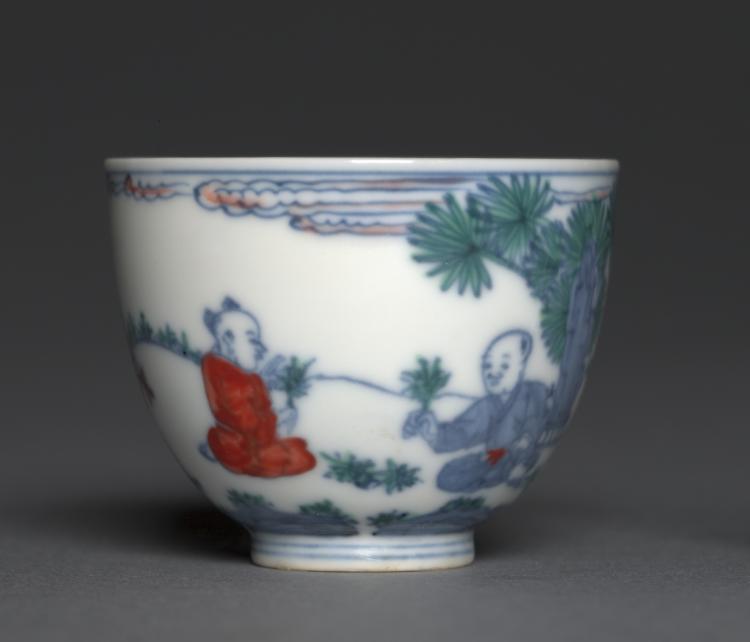
Just two inches tall, this Chenghua doucai cup is the rarest of all classic Chinese porcelains. The body is paper-thin and translucent; the children at play are outlined in cobalt under the glaze, then completed in red, green, and yellow enamels above it — a two-firing technique perfected only at Chenghua's kilns.
From the same era
Other treasures abroad sharing themes or period with this work.
Tang dynasty · Paintings
Night-Shining White
照夜白图
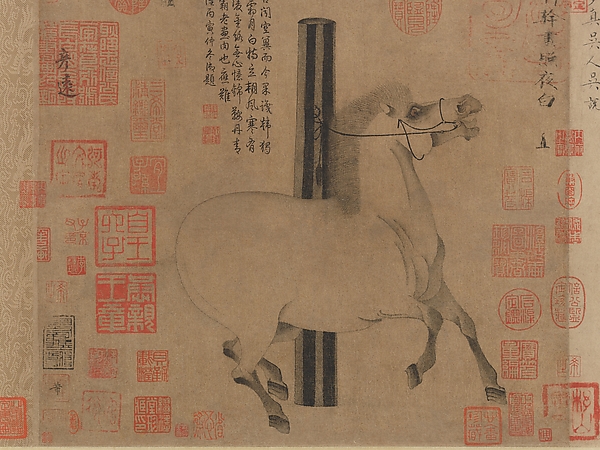
The single most celebrated painting of a horse in Chinese art. Han Gan's ink drawing of Emperor Xuanzong's favourite charger, 'Night-Shining White', has been treasured by collectors for over 1,270 years — its scroll is covered end to end in colophons and seals of the emperors, scholars, and dealers through whose hands it passed.
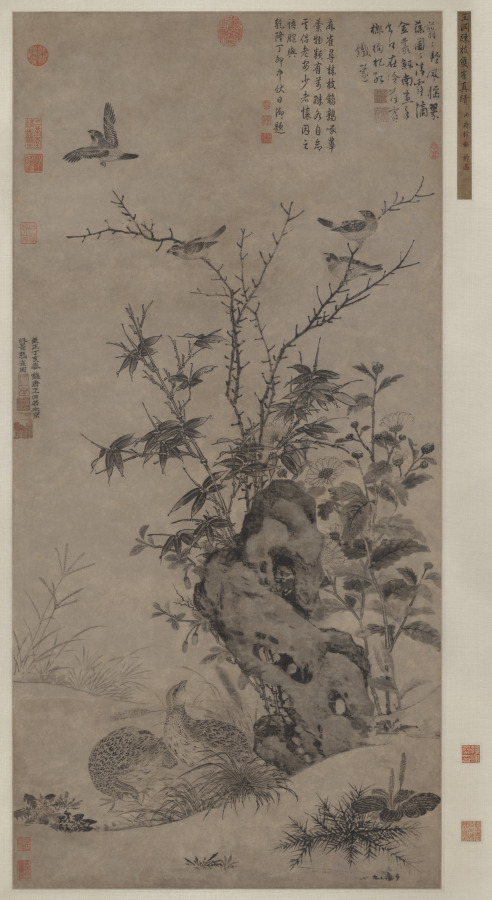
Yuan dynasty · Paintings
Quails and Sparrows in an Autumn Scene
秋景禽雀图
A flower-and-bird painting executed entirely in ink — no color — by Wang Yuan, who studied as a child under the great Yuan scholar-official Zhao Mengfu. Quails crouch beneath autumn millet while sparrows perch on the dry stalks above; every leaf, feather, and seed is rendered with academic precision.

Late Ming dynasty · Paintings
The Five Hundred Arhats
五百罗汉图
A handscroll over 26 metres long depicting 447 luohans (arhats), 72 attendants, and the bodhisattva of compassion at the very end. The luohans are climbing trees, riding tigers, walking on water, conjuring dragons — every supernatural ability the texts ascribe to them, all on one continuous strip of paper.