Mawangdui Nested Lacquer Coffins of Lady Dai
Four nested coffins — each more lavishly decorated than the last — that preserved Lady Dai's body for over 2,100 years in near-perfect condition, representing the pinnacle of Han Dynasty lacquer craftsmanship.

The Story
Lady Dai (Xin Zhui), wife of the Marquis of Dai, died around 163 BC. Her body was placed inside four nested coffins, each sealed with lacquer. The outermost is plain black lacquer; the second features swirling cloud and mythical beast motifs in red and black; the third shows feathered immortals and auspicious animals against black lacquer; the innermost is wrapped in embroidered silk and adorned with feather appliqué. This layered system, combined with charcoal and white clay packing, created an airtight micro-environment that preserved her body so perfectly that when discovered in 1972, her skin was still elastic, joints still movable, and Type A blood was still identifiable. The lacquer technique — building up dozens of thin coats over months — demonstrates industrial-scale craft specialization in the Han Dynasty.
Why It Matters
The world's most famous ancient preservation case and the supreme example of Chinese lacquer art — trending again in 2026 as Li Ziqi's viral lacquerware videos reignite global interest in this 7,000-year-old craft tradition.
Frequently Asked Questions
1. What is Mawangdui Nested Lacquer Coffins of Lady Dai?
Four nested coffins — each more lavishly decorated than the last — that preserved Lady Dai's body for over 2,100 years in near-perfect condition, representing the pinnacle of Han Dynasty lacquer craftsmanship.
2. When was Mawangdui Nested Lacquer Coffins of Lady Dai made?
Mawangdui Nested Lacquer Coffins of Lady Dai dates to c. 168 BC, during the Western Han Dynasty.
3. Where can I see Mawangdui Nested Lacquer Coffins of Lady Dai?
Mawangdui Nested Lacquer Coffins of Lady Dai is held by Hunan Provincial Museum in China. Check the linked collection record or museum website before visiting because display rotations can change.
4. Why is Mawangdui Nested Lacquer Coffins of Lady Dai important?
The world's most famous ancient preservation case and the supreme example of Chinese lacquer art — trending again in 2026 as Li Ziqi's viral lacquerware videos reignite global interest in this 7,000-year-old craft tradition.
5. What is Mawangdui Nested Lacquer Coffins of Lady Dai made of?
Mawangdui Nested Lacquer Coffins of Lady Dai is classified as sculpture and made of Wood with polychrome lacquer, silk, and feather appliqué.
Fun Facts
Lady Dai's last meal (melon seeds) was still identifiable in her stomach after 2,100 years
The lacquer coffins required hundreds of coats applied over months — each coat needs 24+ hours to cure
Chinese lacquer tradition is 7,000 years old — older than ceramics or bronze
Li Ziqi's 2024 lacquerware comeback video got tens of millions of views, reigniting global interest
Where to See It
Public collections holding this artifact or closely related pieces.
Part of These Themes
Related Artifacts
Jade
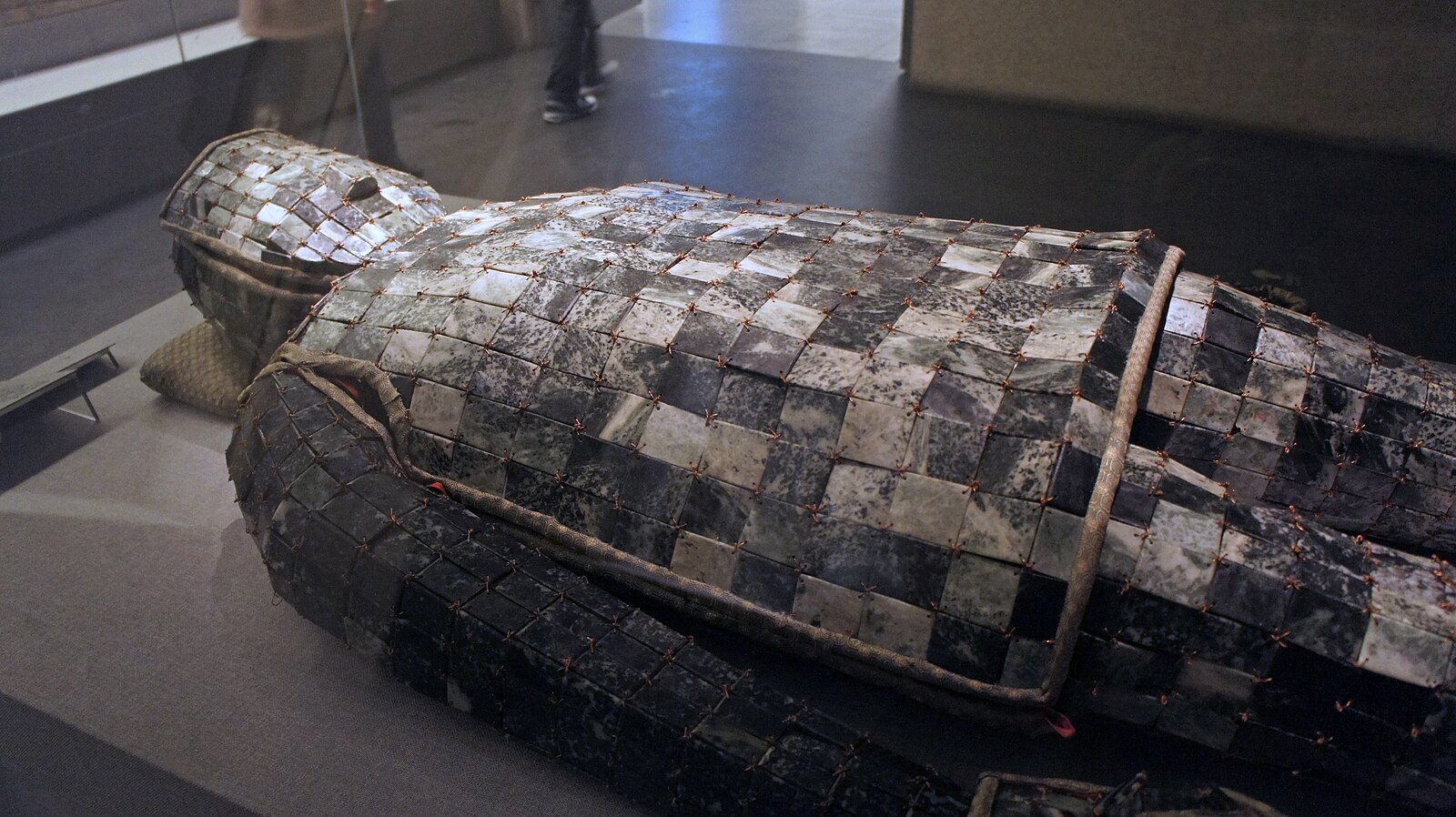
Jade Burial Suit of Prince Liu Sheng
An entire suit made of 2,498 jade tiles sewn together with 1,100 grams of gold wire — built to grant immortality to a Han prince.

Bronze
Changxin Palace Lamp
A gilt-bronze lamp shaped as a kneeling court lady holding a lantern — simultaneously a functional smoke-filtering lamp, a portrait sculpture, and a masterpiece of Han Dynasty engineering and art.

Painting
T-Shaped Silk Funeral Banner of Lady Dai
A 2,200-year-old painted silk banner from the tomb of Lady Dai (Xin Zhui) at Mawangdui — the finest surviving example of Han Dynasty painting and a cosmological map of heaven, earth, and the underworld.
Sources & References
- ·Wikipedia — Xin Zhui (Lady Dai)(CC-BY-SA 3.0)
Content informed by the sources above. Where Wikipedia text is used, it is licensed under CC-BY-SA 3.0.