T-Shaped Silk Funeral Banner of Lady Dai
A 2,200-year-old painted silk banner from the tomb of Lady Dai (Xin Zhui) at Mawangdui — the finest surviving example of Han Dynasty painting and a cosmological map of heaven, earth, and the underworld.

The Story
Draped over the innermost coffin of Lady Dai, this T-shaped silk banner (feiyi 非衣) is a visual guide for the soul's journey after death. Reading from top to bottom, it depicts three realms: the heavenly world (sun, moon, dragons, celestial gates), the earthly realm (Lady Dai herself, attended by servants, receiving ritual offerings), and the underworld (a giant figure standing on intertwined fish, supporting the earth above). The painting is executed with extraordinary finesse — flowing brushwork, vibrant mineral pigments (cinnabar red, azurite blue, malachite green), and a compositional sophistication that rivals anything in Western art for another thousand years. Discovered in 1972 when the Mawangdui tombs were excavated during a Cold War bomb-shelter construction project, the banner's near-perfect preservation shocked archaeologists.
Why It Matters
The most important surviving painting from pre-imperial and early imperial China — a cosmological masterpiece that redefined understanding of Han Dynasty art, religion, and afterlife beliefs.
Frequently Asked Questions
1. What is T-Shaped Silk Funeral Banner of Lady Dai?
A 2,200-year-old painted silk banner from the tomb of Lady Dai (Xin Zhui) at Mawangdui — the finest surviving example of Han Dynasty painting and a cosmological map of heaven, earth, and the underworld.
2. When was T-Shaped Silk Funeral Banner of Lady Dai made?
T-Shaped Silk Funeral Banner of Lady Dai dates to c. 168 BC, during the Western Han Dynasty.
3. Where can I see T-Shaped Silk Funeral Banner of Lady Dai?
T-Shaped Silk Funeral Banner of Lady Dai is held by Hunan Provincial Museum in China. Check the linked collection record or museum website before visiting because display rotations can change.
4. Why is T-Shaped Silk Funeral Banner of Lady Dai important?
The most important surviving painting from pre-imperial and early imperial China — a cosmological masterpiece that redefined understanding of Han Dynasty art, religion, and afterlife beliefs.
5. What is T-Shaped Silk Funeral Banner of Lady Dai made of?
T-Shaped Silk Funeral Banner of Lady Dai is classified as painting and made of Mineral pigment and ink on silk.
Fun Facts
Discovered during a Cold War bomb-shelter excavation in 1972
Lady Dai's body was so well preserved that her skin was still elastic and blood type could be determined
The banner's three-realm cosmology matches descriptions in the Chu Ci (Songs of the South)
Over 1,400 objects were found in Lady Dai's tomb including silk manuscripts, lacquerware, and food
Where to See It
Public collections holding this artifact or closely related pieces.
Part of These Themes

Chinese Lacquer Art & Intangible Heritage
7,000 Years of the World's Oldest Plastic — From Neolithic Bowls to Li Ziqi's Viral Videos
Chinese lacquerware is the world's oldest continuous craft tradition — 7,000 years of coating, carving, and inlaying tree sap into objects of extraordinary beauty, now trending globally thanks to viral videos and renewed interest in intangible cultural heritage.
3 artifacts →

Feng Shui Compass & Cosmic Orientation
How the luopan turned direction, time, landscape, and the cosmos into one instrument
The feng shui compass, or luopan, is not just a navigation tool. Its rings encode trigrams, stems, branches, stars, and spatial formulas used to align buildings, graves, and landscapes.
4 artifacts →
Related Artifacts
Jade
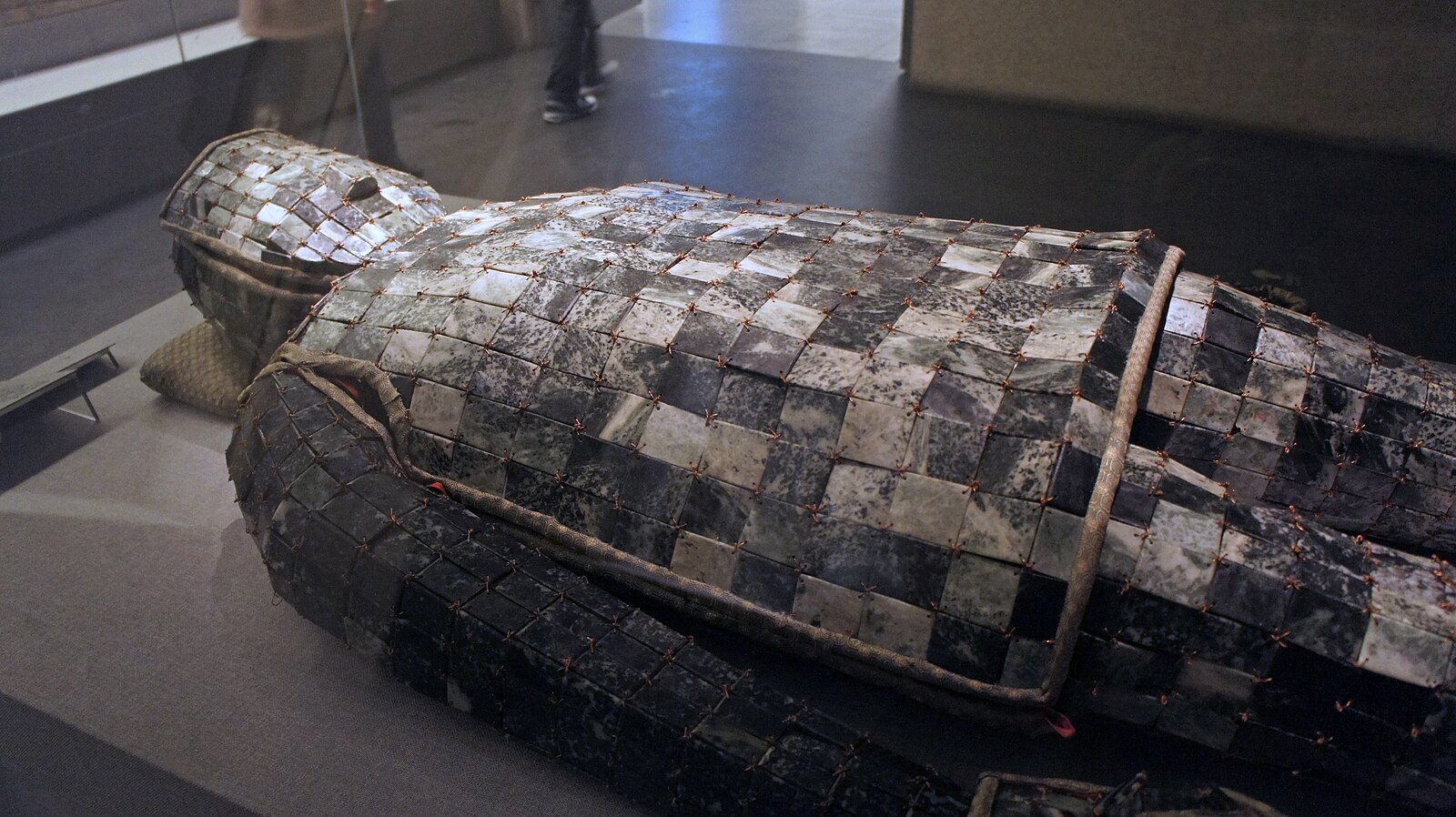
Jade Burial Suit of Prince Liu Sheng
An entire suit made of 2,498 jade tiles sewn together with 1,100 grams of gold wire — built to grant immortality to a Han prince.

Bronze
Changxin Palace Lamp
A gilt-bronze lamp shaped as a kneeling court lady holding a lantern — simultaneously a functional smoke-filtering lamp, a portrait sculpture, and a masterpiece of Han Dynasty engineering and art.
Painting
Mawangdui Silk Manuscripts (Boshu)
Over 50 texts written on silk — including lost versions of the Dao De Jing, medical treatises, astronomical charts, and military maps — the single most important manuscript discovery in Chinese archaeology.
Silk / Textile
Mawangdui Silk Manuscript of the I Ching
One of the earliest surviving manuscript witnesses to the I Ching, copied on silk and buried in the Mawangdui Han tombs before later received editions became canonical.
Sources & References
- ·Wikipedia — Mawangdui(CC-BY-SA 3.0)
- ·Smarthistory — Tomb of Lady Dai
Content informed by the sources above. Where Wikipedia text is used, it is licensed under CC-BY-SA 3.0.