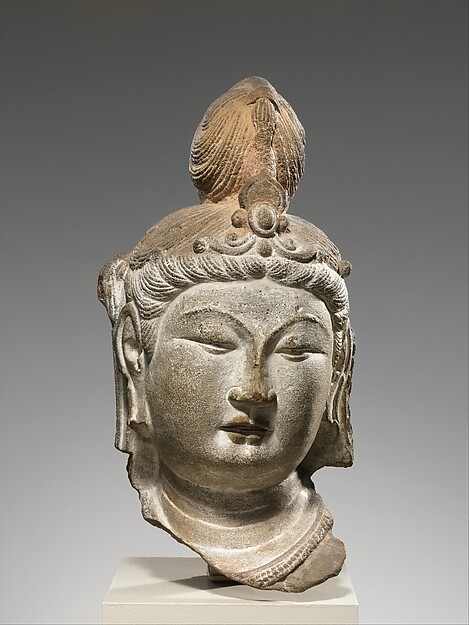
Head of a Bodhisattva
菩萨石刻头像
A serene Tang-dynasty bodhisattva head, sliced clean from a once-colossal cave-temple statue. Its softly downcast eyes and jewelled crown represent the mature classical style that spread from Longmen across East Asia.
Object Facts
- Period
- Tang dynasty (618–907)
- Date
- ca. early 8th century
- Medium
- Sandstone with pigment
- Dimensions
- H. 40 cm; W. 20.3 cm; D. 19.1 cm
- Held by
- The Metropolitan Museum of Art
New York, USA - Accession
- 42.25.12
Gift of Abby Aldrich Rockefeller, 1942
Why it matters
Embodies the 'international style' of the Tang court — a synthesis of Indian Gupta, Central Asian, and Chinese forms that became the template for Buddhist art in Korea, Japan, and Vietnam.
How it travelled
Severed heads like this flooded the Western market in the 1910s–30s after the great cave temples at Longmen, Tianlongshan, and Xiangtangshan were stripped by dealers. Abby Rockefeller purchased it for her Chinese art collection and gifted it to the Met in 1942.
Frequently asked questions
Where can I see Head of a Bodhisattva?+
Head of a Bodhisattva is held by the The Metropolitan Museum of Art in New York, USA. Accession number 42.25.12. Online catalogue record: https://www.metmuseum.org/art/collection/search/39640.
When was Head of a Bodhisattva created?+
Head of a Bodhisattva dates to ca. early 8th century, during the Tang dynasty (618–907).
What is Head of a Bodhisattva made of?+
Head of a Bodhisattva is a sandstone head executed in sandstone with pigment, measuring H. 40 cm; W. 20.3 cm; D. 19.1 cm.
How did Head of a Bodhisattva end up at the The Met?+
Severed heads like this flooded the Western market in the 1910s–30s after the great cave temples at Longmen, Tianlongshan, and Xiangtangshan were stripped by dealers. Abby Rockefeller purchased it for her Chinese art collection and gifted it to the Met in 1942.
Can I reuse the photograph of Head of a Bodhisattva?+
Yes. The The Met has released the image under Creative Commons Zero (CC0), so it is free for any use, commercial or non-commercial, with no attribution required (though attribution is appreciated).
More Chinese pieces at The Met
Other Chinese works in the The Metropolitan Museum of Art collection.
Tang dynasty · Paintings
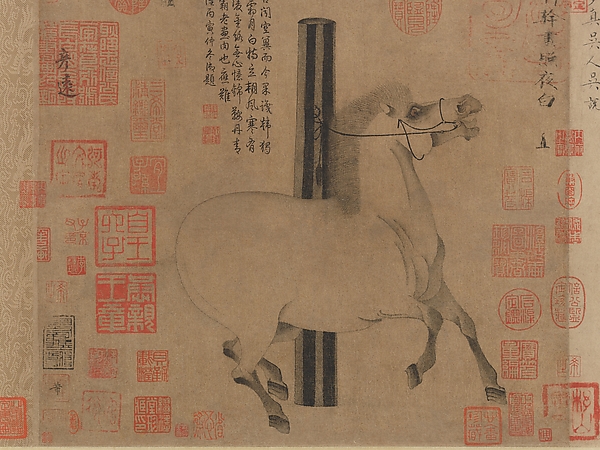
Night-Shining White
照夜白图
The single most celebrated painting of a horse in Chinese art. Han Gan's ink drawing of Emperor Xuanzong's favourite charger, 'Night-Shining White', has been treasured by collectors for over 1,270 years — its scroll is covered end to end in colophons and seals of the emperors, scholars, and dealers through whose hands it passed.
Tang dynasty · Tomb Pottery
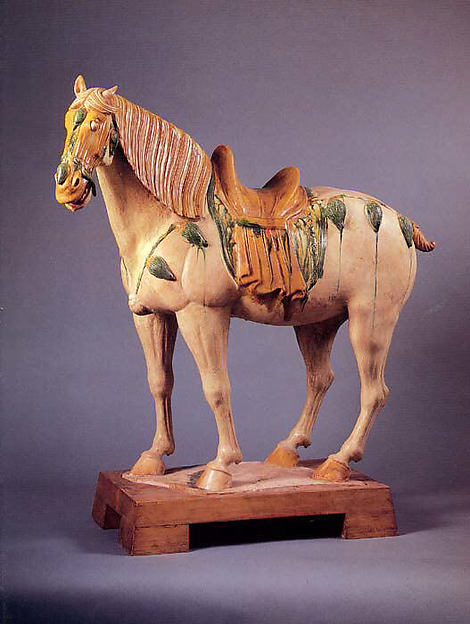
Sancai-Glazed Horse
唐三彩马
A nearly life-size ceramic horse glazed in the signature amber, green, and cream of Tang sancai ware. Its powerful stance and flared nostrils capture the Ferghana chargers that Tang emperors imported at ruinous expense along the Silk Road.
Northern Wei dynasty · Sculpture
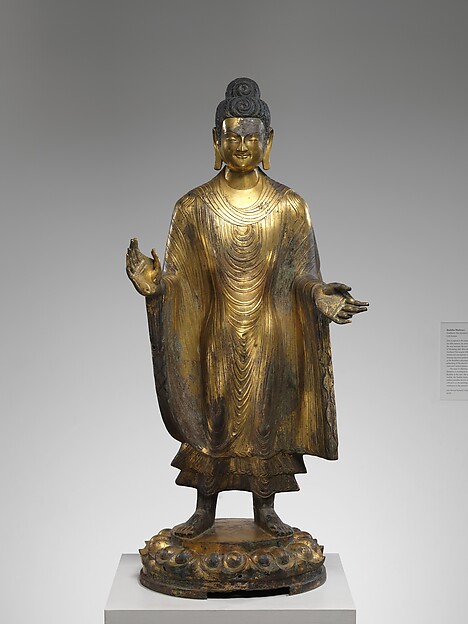
Buddha Maitreya (Mile)
弥勒佛立像
The earliest precisely-dated monumental Chinese Buddhist bronze known to survive anywhere. An inscription on the base tells us it was cast in 486 CE by a nun named Fayi and 66 of her fellow devotees.
From the same era
Other treasures abroad sharing themes or period with this work.
Tang dynasty · Ceramics
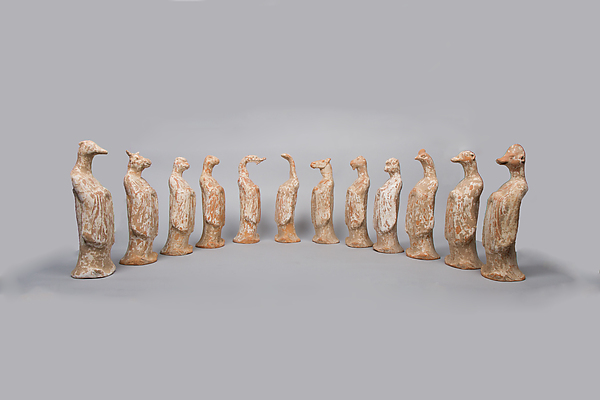
Set of Twelve Zodiac Animals
唐十二生肖俑
A complete set of the twelve Chinese zodiac animals, each modelled on a human body — rat, ox, tiger, rabbit, dragon, snake, horse, goat, monkey, rooster, dog, pig. They stood guard in the four directions around a Tang tomb.
Qing dynasty · Jade
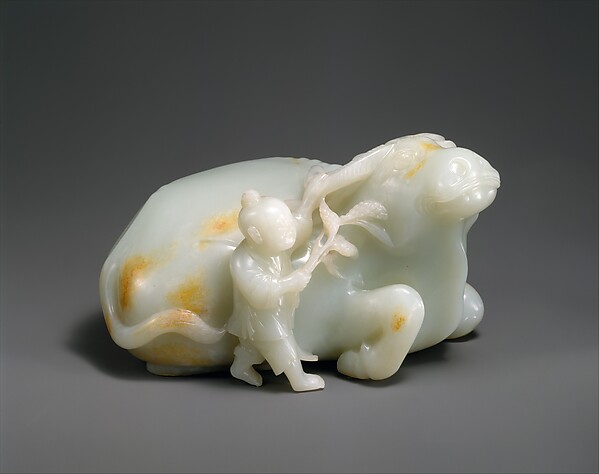
Boy with Water Buffalo
清玉雕牧童与水牛
A pale-celadon nephrite carving of a small boy reclining on the back of a docile water buffalo. The motif draws on the Chan Buddhist parable of the herder taming the bull, and on the broader Confucian ideal of pastoral simplicity.

Late Ming dynasty · Paintings
The Five Hundred Arhats
五百罗汉图
A handscroll over 26 metres long depicting 447 luohans (arhats), 72 attendants, and the bodhisattva of compassion at the very end. The luohans are climbing trees, riding tigers, walking on water, conjuring dragons — every supernatural ability the texts ascribe to them, all on one continuous strip of paper.