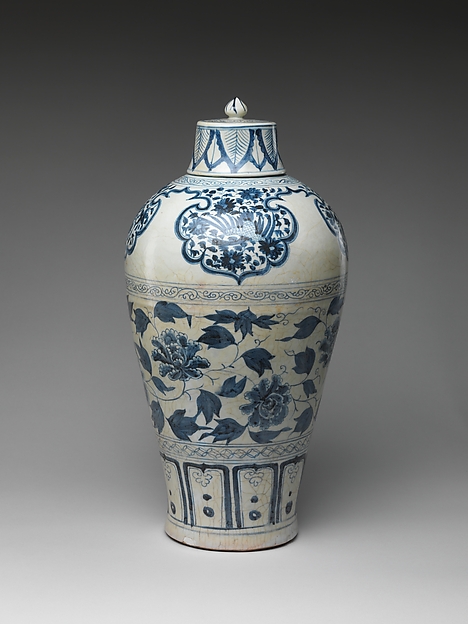
Bottle with Peony Scroll
青花缠枝牡丹纹梅瓶
A quintessential Yuan blue-and-white meiping, its shoulders wrapped in a dense peony scroll painted in cobalt imported from Persia via the Silk Road. Early blue-and-whites were made first for export to the Islamic world — only later did Chinese collectors embrace the palette.
Object Facts
- Period
- Yuan dynasty (1271–1368)
- Date
- mid-14th century
- Medium
- Porcelain painted with cobalt blue under a transparent glaze (Jingdezhen ware)
- Dimensions
- H. 44.5 cm
- Held by
- The Metropolitan Museum of Art
New York, USA - Accession
- 26.271.1a, b
Rogers Fund, 1926
Why it matters
Yuan blue-and-white is the pivot point of world ceramic history: the moment Jingdezhen invented the aesthetic that would dominate European and Middle Eastern tables for the next 600 years.
How it travelled
Acquired by the Met via the Rogers Fund in 1926. Yuan blue-and-whites surfaced in the West chiefly through Ottoman and Persian palace dispersals in the 19th–20th centuries, supplemented by tomb finds in North China.
Frequently asked questions
Where can I see Bottle with Peony Scroll?+
Bottle with Peony Scroll is held by the The Metropolitan Museum of Art in New York, USA. Accession number 26.271.1a, b. Online catalogue record: https://www.metmuseum.org/art/collection/search/49216.
When was Bottle with Peony Scroll created?+
Bottle with Peony Scroll dates to mid-14th century, during the Yuan dynasty (1271–1368).
What is Bottle with Peony Scroll made of?+
Bottle with Peony Scroll is a meiping bottle executed in porcelain painted with cobalt blue under a transparent glaze (jingdezhen ware), measuring H. 44.5 cm.
How did Bottle with Peony Scroll end up at the The Met?+
Acquired by the Met via the Rogers Fund in 1926. Yuan blue-and-whites surfaced in the West chiefly through Ottoman and Persian palace dispersals in the 19th–20th centuries, supplemented by tomb finds in North China.
Can I reuse the photograph of Bottle with Peony Scroll?+
Yes. The The Met has released the image under Creative Commons Zero (CC0), so it is free for any use, commercial or non-commercial, with no attribution required (though attribution is appreciated).
More Chinese pieces at The Met
Other Chinese works in the The Metropolitan Museum of Art collection.
Tang dynasty · Paintings
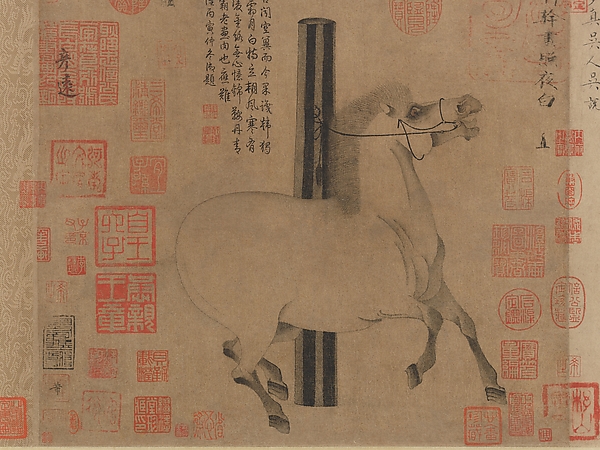
Night-Shining White
照夜白图
The single most celebrated painting of a horse in Chinese art. Han Gan's ink drawing of Emperor Xuanzong's favourite charger, 'Night-Shining White', has been treasured by collectors for over 1,270 years — its scroll is covered end to end in colophons and seals of the emperors, scholars, and dealers through whose hands it passed.
Tang dynasty · Tomb Pottery
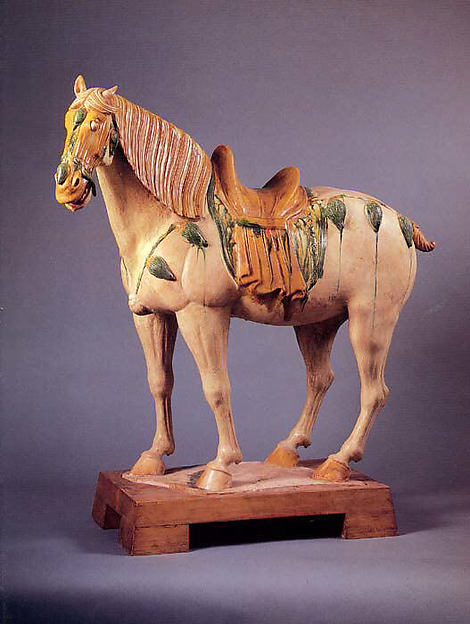
Sancai-Glazed Horse
唐三彩马
A nearly life-size ceramic horse glazed in the signature amber, green, and cream of Tang sancai ware. Its powerful stance and flared nostrils capture the Ferghana chargers that Tang emperors imported at ruinous expense along the Silk Road.
Northern Wei dynasty · Sculpture
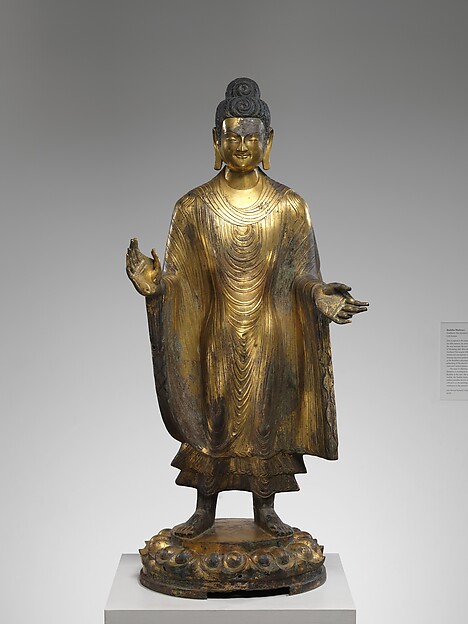
Buddha Maitreya (Mile)
弥勒佛立像
The earliest precisely-dated monumental Chinese Buddhist bronze known to survive anywhere. An inscription on the base tells us it was cast in 486 CE by a nun named Fayi and 66 of her fellow devotees.
From the same era
Other treasures abroad sharing themes or period with this work.
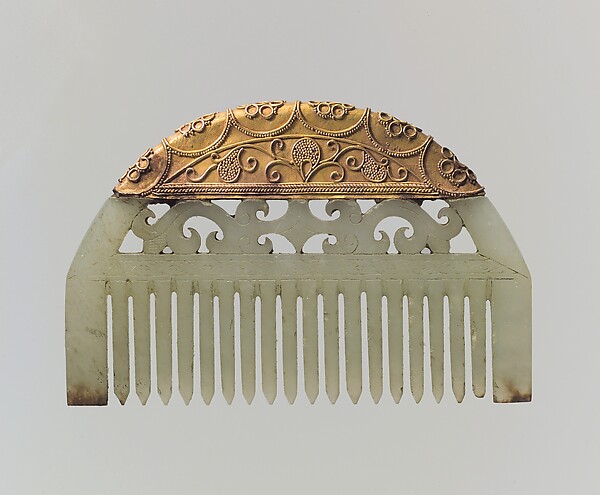
Eastern Han dynasty · Jade
Jade-and-Gold Comb
东汉嵌玉金梳
A miniature Eastern Han hair comb: a slab of pale nephrite jade clipped into a tracery of granulated gold work depicting two confronted dragons among clouds. A jewel built for an aristocratic woman's coiffure.
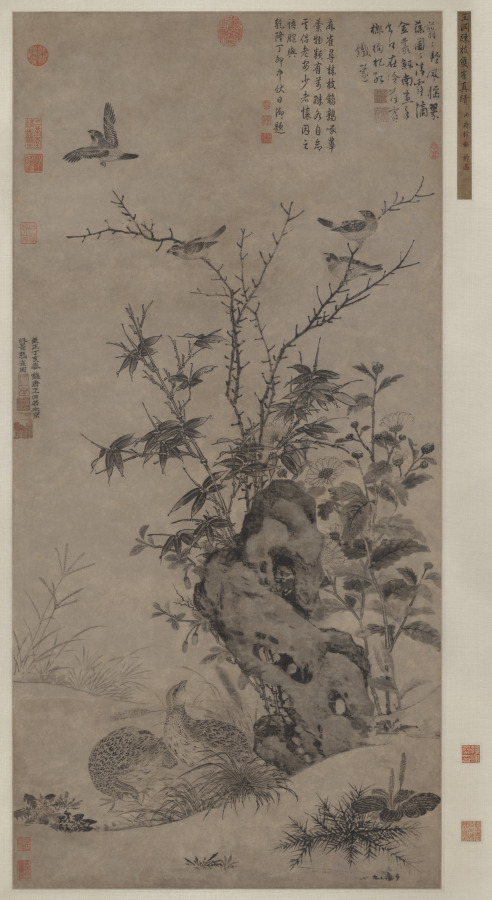
Yuan dynasty · Paintings
Quails and Sparrows in an Autumn Scene
秋景禽雀图
A flower-and-bird painting executed entirely in ink — no color — by Wang Yuan, who studied as a child under the great Yuan scholar-official Zhao Mengfu. Quails crouch beneath autumn millet while sparrows perch on the dry stalks above; every leaf, feather, and seed is rendered with academic precision.
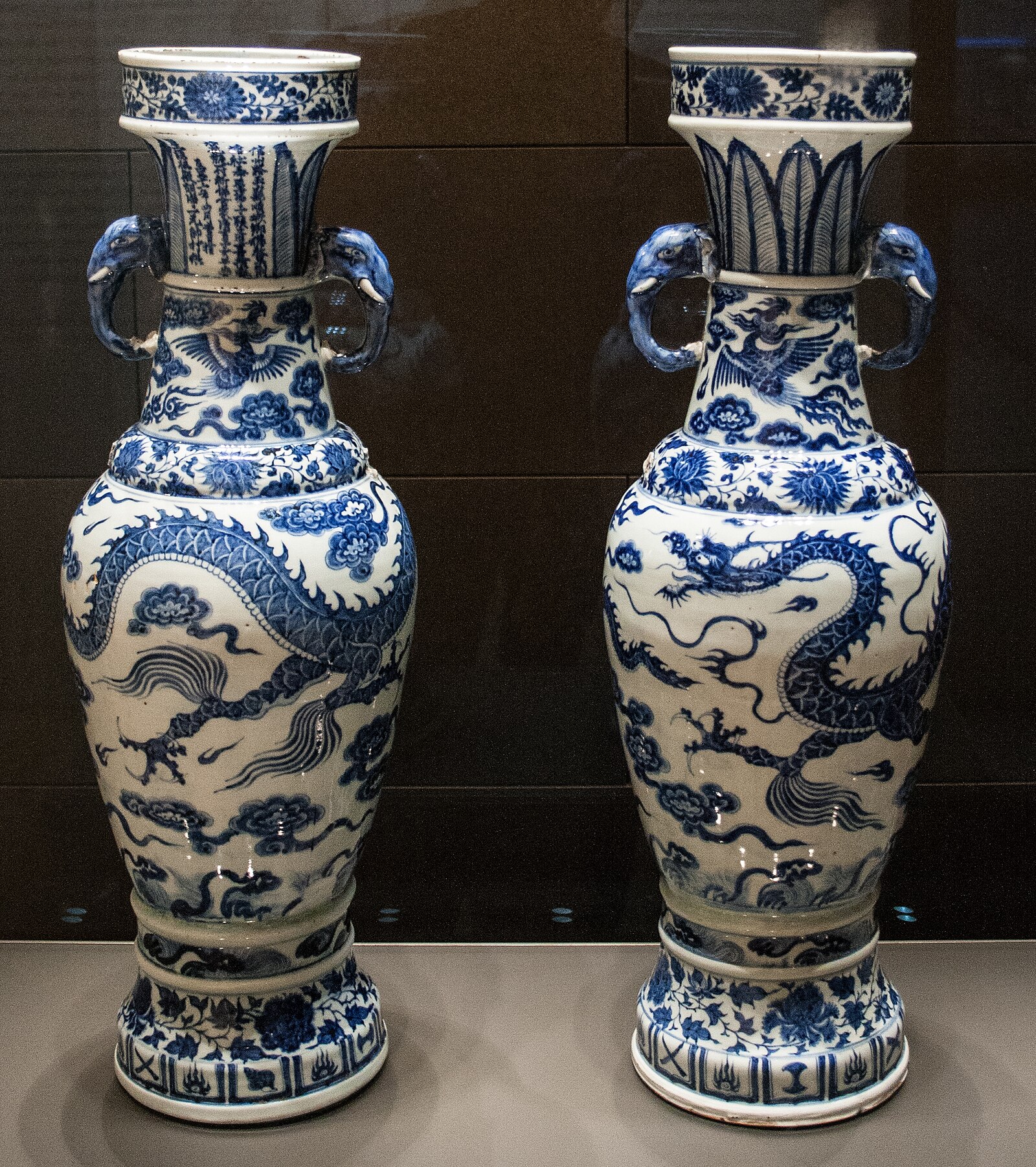
Yuan dynasty, Zhizheng era · Ceramics
The David Vases
至正型青花云龙象耳瓶
A pair of cobalt-blue temple vases dated by inscription to 1351 — the rosetta stone of blue-and-white porcelain. Until Sir Percival David identified these in 1929, scholars wrongly assumed blue-and-white only began in the Ming dynasty.